Clay vs Pomade vs Paste vs Wax: What's Actually the Difference?
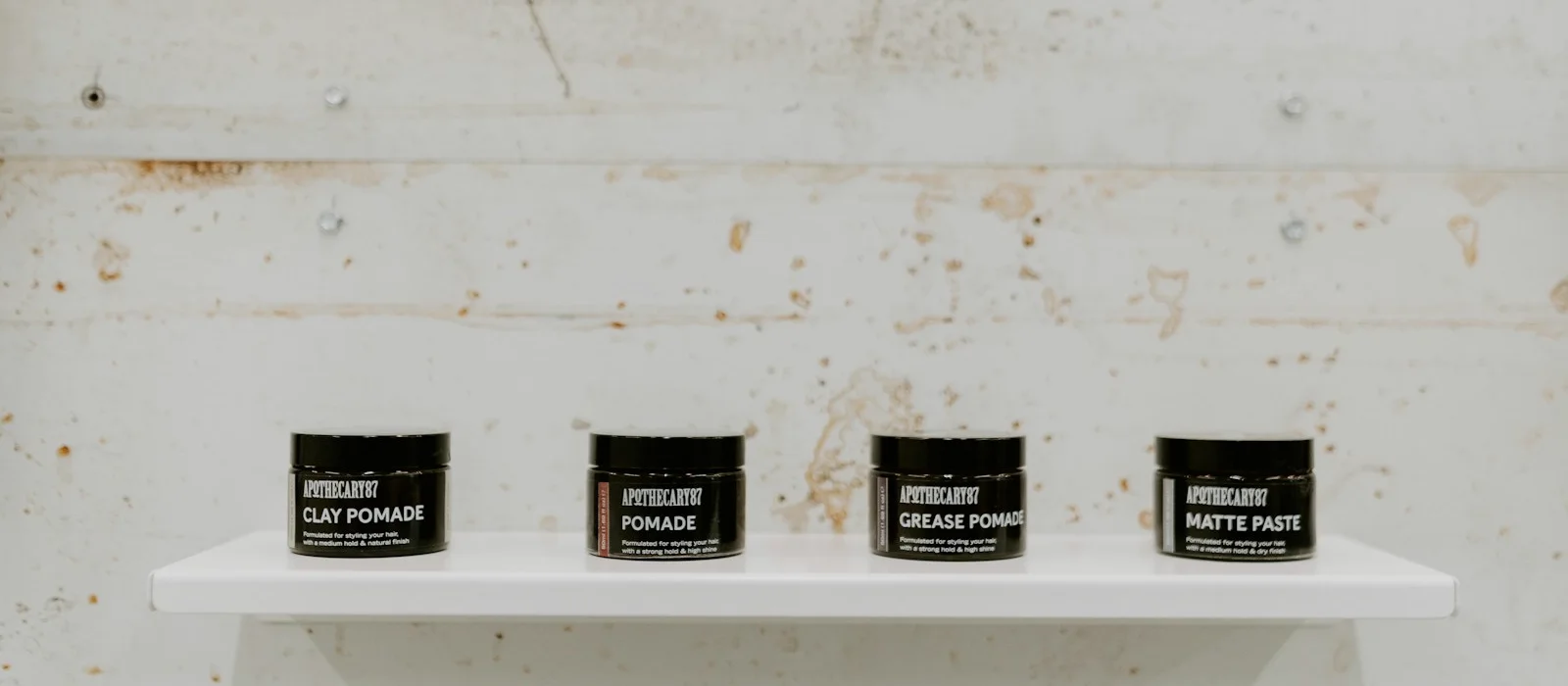
Four tubs that look identical on the shelf and behave nothing alike in your hair. Here's what's really inside each one, and how to work out which belongs on your bathroom shelf.
Key takeaways
- Clay is mineral clay in a wax base. It absorbs oil, finishes truly matte, and makes hair look thicker than it is.
- Pomade is the shine option, and splits into two very different things: water-based (rinses out easily) and oil-based (holds harder, fights back at wash time).
- Paste is the water-and-wax hybrid: medium hold, low sheen, and restylable at 4pm without re-wetting.
- Wax grips hair to hair rather than setting it. Best for separation and flyaways, worst for buildup on fine hair.
- Choose in this order: finish, then hold, then how easily it washes out.
Walk into any barbershop and you'll find four tubs that cost about the same, weigh about the same, and give you almost no clue how they'll behave. The labels don't help much either. None of these category names are regulated, so one brand's "paste" is another brand's "cream".
What actually separates them is what they're built from. Once you know that, the choice gets obvious.
The quick answer
| Clay | Pomade | Paste | Wax | |
|---|---|---|---|---|
| Built on | Kaolin / bentonite clay + wax | Water + polymers, or oil + petrolatum | Water + wax | Beeswax / carnauba + oils |
| Hold | Medium-firm | Medium-firm (firmer if oil-based) | Medium | Medium, grippy |
| Finish | True matte | Shiny | Low sheen | Low-medium sheen |
| Restyle later? | Hard once it sets | Water-based: re-wet. Oil: anytime | Yes, anytime | Yes |
| Washing out | One wash | Water: one wash. Oil: clarify or double-wash | One wash | Often two |
| Best at | Volume and texture on fine hair | Slick backs and sharp parts | Being the safe all-rounder | Separation and flyaways |
Clay
Hair clay is exactly what it sounds like: mineral clay (usually kaolin, bentonite or both) suspended in a wax and oil base.
Those clays do two things at once. They absorb oil, which is what produces the genuinely matte finish, and they coat each strand, which fractionally increases its apparent diameter. That combination is why clay makes hair look fuller than it really is, and why it's the standard recommendation for fine or thinning hair. Bentonite is the more absorbent of the two; kaolin is gentler and less drying.
Best for: textured crops, messy quiffs, fine hair that needs apparent density, anyone whose scalp runs oily.
The catch: clay is absorbing oil from your scalp as well as your hair, so daily use can leave both feeling dry. It's also the stiffest product in the tub. If you don't warm it properly between your palms first, it lands in clumps and never distributes.
Matte finishes scatter light; shiny finishes reflect it. If your scalp is showing through, that difference is the whole ballgame.
Pomade (and why there are two kinds)
Pomade is the shine product, but "pomade" covers two formulations that have almost nothing in common beyond the name.
Water-based pomade
Built on water, film-forming polymers and glycerin. It dries down slightly, sets to a medium-firm hold, and rinses out with a single normal shampoo. You can also reactivate it the next morning with a splash of water. This is the modern default and what most people should buy.
Oil-based pomade (the traditional "grease")
Built on petrolatum, mineral oil, lanolin and beeswax. It never dries, which means it stays pliable for days and gives the heaviest shine and the strongest control of anything here. The trade-off is at the sink: the same water-repelling ingredients that make it hold make it stubborn to remove, usually needing a clarifying shampoo, a double wash, or a conditioner applied first to break the grease down. It also transfers happily onto pillowcases and shirt collars.
Best for: slick backs, side parts, pompadours, and thick, straight hair that shrugs off lighter products.
The catch: shine reflects off the scalp. If you're thinning on top, a high-shine pomade will draw the eye straight to it.
Paste
Paste is the hybrid: water and wax together, usually thicker and creamier than a wax on its own. Medium hold, low sheen, nothing extreme in any direction.
Its real distinguishing feature is pliability. Because it doesn't set hard, you can push your hair back into shape at four in the afternoon without re-wetting it and without the result looking obviously handled. Nothing else here does that as gracefully.
Best for: people who genuinely don't know what they want yet, wavy hair, and short-to-mid cuts that need movement rather than architecture.
The catch: it's a compromise by design. If you want a genuinely matte finish, clay beats it; if you want a sharp part that survives the day, pomade beats it.
Wax
Wax is wax-dominant: beeswax, carnauba or microcrystalline wax with oils blended in. The key difference from the others is how it holds: wax doesn't set your hair into a shape so much as grip hair to hair, welding strands into pieces.
That makes it the specialist for piecey separation, spiky texture, and pressing down flyaways at the end of styling, including as a finishing layer over something else.
The catch: it's the heaviest of the four on fine hair, it builds up faster than anything except oil-based pomade, and waxes soften with heat. On a hot or humid day, wax loses its grip earlier than clay will.
How to choose, in order
Three decisions, and the order matters, because finish is the most visible and the hardest to work around.
The third question catches more people than the first two. If you style every morning but only wash twice a week, an oil-based pomade will be sitting on your scalp for days at a time, and that's where the itching starts.
Tip: Your hair type narrows this further. Fine hair wants light and matte; thick or coarse hair needs real weight and hold or the style springs open by lunchtime. Our short hair routine guide breaks the choice down type by type.
Where gel, cream and mousse fit
Those four cover most of the shelf, but three other categories come up constantly and are worth placing on the same map.
- Gel is the firmest hold available and the only one that genuinely sets hard. Modern formulas dry matte rather than wet-look. It earns its place on very thick or curly hair that lighter products simply cannot hold, but once the cast is broken by running your hands through it, you get frizz rather than a restyle.
- Cream is the lightest thing here. It barely holds at all; the job is smoothing, softening and knocking back frizz while leaving hair looking essentially undone. Ideal for wavy hair, and for anyone whose style is really just tidier hair.
- Mousse goes into damp hair before drying rather than onto finished hair. It adds volume and curl definition with almost no weight, which makes it one of the few genuinely useful options for very fine hair.
Mousse especially isn't a rival to the four above. It's a pre-styler you use before one of them, and the pairing beats either on its own.
Getting it back out again
This is the half of the decision nobody makes at the till, and it's where most scalp complaints come from.
- Clay, paste and water-based pomade: one normal shampoo, applied to the scalp, is usually enough.
- Wax: often needs two passes. Wax repels water by design, so the first shampoo mostly just breaks the surface.
- Oil-based pomade: use a clarifying shampoo, or work conditioner (or an oil) through dry hair first to dissolve the grease, then shampoo. Water alone will do essentially nothing.
Whatever you use, don't keep topping up on the same product for days. Buildup traps sebum and dead skin against the scalp, and the itching and flaking that follows gets misdiagnosed as dandruff constantly. If you style daily, add one clarifying wash a week and the problem disappears.
How much to use, and layering
- Start smaller than you think. A pea for short or fine hair, up to an almond for thick hair. You can always add more; you cannot take it out without washing.
- Emulsify properly. Rub it between your palms until it turns clear and effectively disappears. Clay especially needs the warmth. Unwarmed clay lands in visible lumps.
- Damp beats dry for clay, paste and water-based pomade: it spreads them further. Wax and oil-based pomade prefer dry hair. Curly hair prefers soaking wet.
- Layer a pre-styler, not two hold products. A salt spray or mousse before drying, then your main product, gives far more volume than either alone. Stacking two firm-hold products just adds weight.
- Wax over clay is the one combination genuinely worth knowing: clay for the shape, then a trace of wax to press down flyaways.
The category on the lid matters less than matching hold, finish and washout to your actual hair. That's the part Hairmony works out for you. It reads your hair from a photo, scores 22 characteristics, and matches products to the result instead of leaving you to translate marketing copy in the aisle.
Frequently asked questions
Is clay pomade the same as clay?
Not quite. "Clay pomade" is a hybrid: a clay-based product with more slip and a little more shine than a pure clay. None of these category names are regulated, so two tubs both labelled "paste" can behave completely differently. Judge a product by its stated hold and finish and by its ingredient list, not by the word on the lid.
Which styling product lasts longest through the day?
Firm clay and oil-based pomade last longest, for opposite reasons: clay sets hard and stays set, while oil-based pomade never sets at all, so there's nothing to break. Paste and wax are designed to move, so they don't fail so much as gradually relax. Heat and humidity soften wax fastest.
Do clay or wax damage your hair?
Not the hair shaft itself. These products sit on the outside of the strand and wash off. The real risk is the scalp: layering product for days without washing traps sebum and dead skin, which causes itching and flaking that people often mistake for dandruff. Wash the product out properly, and clarify weekly if you style every day.
Should I apply styling product to wet or dry hair?
Damp is best for clay, paste and water-based pomade. The water helps them spread and roughly doubles how far a given amount goes. Wax and oil-based pomade work better in dry or nearly dry hair, since water repels them. Curly hair is the exception: apply to soaking wet hair to encourage the curls to clump.
Keep reading

The Hairmony Team
We're the team behind Hairmony, the app that reads your hair from a photo and builds a routine around it. We write these guides to make the science of hair care simple and actually usable.

The label won't tell you. Your hair will.
Hairmony reads your hair from a photo and matches products by what they actually do (oil control, volume, curl definition, frizz control) instead of the word on the tub.
Try Hairmony free for 3 days →